(Philosophy – Straight Photography
Its rather flattering when someone mistakenly thinks one of my images is “improved” with Photoshop. However . . .
No Faux-tographs —
None of my fine art images are modified in any way with AI or Photoshop, though I correct some using DXO (extraordinary control of dark areas & brights) and sometimes Lightroom (sometimes better skin tones).
The reason is — I value natural reality and do not believe it is possible to improve on nature’s beauty.
You will not find any photographs of “perfect” landscapes here.
What you will find is perfectly natural spectacular landscapes at magnificent monents. Some flowers may be past their prime and some grass may have started to yellow. The only thing I do to manipulate a landscape is occasionally I will bend or remove some obvious weeds prior to making a photograph. So shoot me.
Corrections Only
To make an image “pop,” some photographers crank up the saturation (sadly including some of Galen Rowell’s fabulous images). Mine never have increased saturation. While I do adjust some images slightly, it is only to correct them so that they genuinely represent the natural phenomena that I saw at that time. I intentionally do not knowingly adjust my images by an amount larger than the errors introduced by the camera system.
Just as a library separates books, I believe there are two types of images:
Fiction and non-fiction.
You will find my photographs are non-fiction – the real deal. They have a remarkable resemblance to what the actual landscape or cloudscape genuinely looked like. I’m not alone in this sentiment. The Reuters news organization has a similar set of rules / limits (“The use of Photoshop“) for its own photographers.
While some photographers, including some who are very well known, produce photographs that can accurately be called “fiction” because they represent a scene that never existed. One highly successful Pebble Beach photographer puts a Moon – wherever he likes – including in impossible places. “Not that there’s anything wrong with that” as one comedian quipped – its just not me.
Aiming
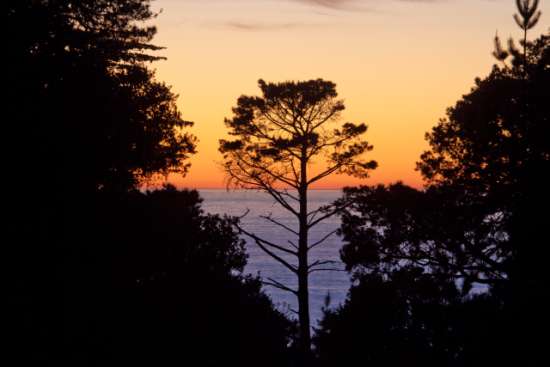
Monterey Pine Icon
But it is possible to compose, to line natural features up, by being in the right place at the right moment for fabulous light. Or as Ansel Adams said “a good photograph is knowing where to stand.”
Prediction
It is also somewhat possible to predict when a place will look spectacular. What my photographs provide is my skill at finding places where natural phenomena looks most fabulous, and knowing specific moments when those places will exhibit magical beauty, like sunsets, moon-rises or sun rises. (I bet you were up to photograph this morning’s sun rise, right?)
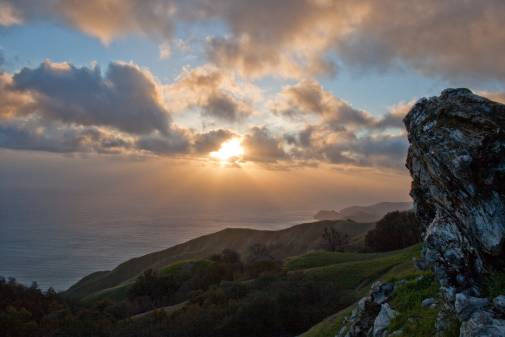
Olympus Sunset
However, even knowing when wonderful light will illuminate a great place, I’ve made images in some places where I could visit another 1,000 times and never again see similar clouds or flower arrangements that I’ve captured.
Correction vs Manipulation
Adams also once wrote “You don’t take a photograph, you make it.”
On this point I most respectfully have a different philosophy. I do not try to “make” photographs look differently than the natural vision I saw. My goal is to show as closely as possible what the actual landscape or vision looked like at the moment I was there.
All images are as close as I can get them to the true natural light reflected or emitted by the real natural phenomena at the place and moment it was photographed.
Adjust – Only to Correct Camera Errors
Every camera system makes errors in capturing a vision. Some of those include color skew, barrel and pincushion (rectilinear distortion), and noise.
(Did you know most DSLR cameras (including Canon and Nikon) use Bayer Pattern chips which have to guess most colors. On top of that, as of 2011, all DSLRs use a filter that intentionally blurs images. I wish I was kidding. Thankfully as of 2025 there are several professional DSLR cameras that have eliminated those filters. Nikon led the way, but Canon is getting dragged into it kicking and screaming in protest.)
While I do not use color filters (like the red filter Ansel Adams used to dramatically darken the sky for Moon and Half Dome), the one filter I do occasionally use that does change what your bare eyes see is a polarizing filter to help capture what you could see when polarizing sunglasses remove some glare.
I’ve seen plenty of high dynamic range (HDR) photography, but just don’t like the results. The worst look plastic, the best just don’t look real. However, let me predict that by 2017, camera technology will for the first time be able to capture dynamic range that exceeds what we can see with our eyes.
In any case, none of my images are modified in any way with Photoshop. (I don’t even have it on any computer) None are dodged or burned or contain parts of any other image or have anything except dust spots removed.
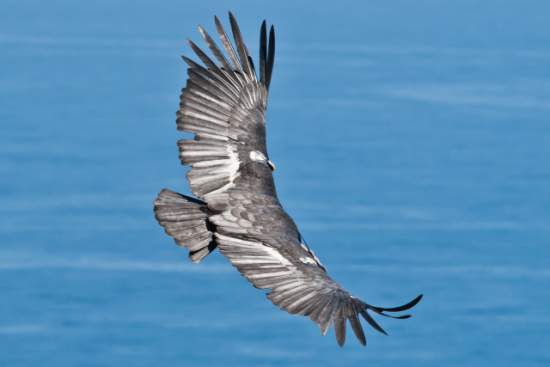
Condor Floating
For my fine art photographs, I do not use bait, hire or rent animals as models, or take images of animals controlled by humans (No zoo animals or wild animal ranches). All the animals in my fine art photographs are truly wild and free.
(I have taken commercial pet photographs and images of animals in research studies and zoos, but those images are not part of my fine art work.)
Astronomy Reality
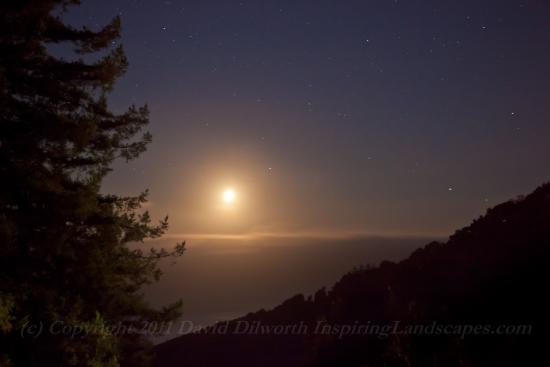
Moonset Over Fog, Big Sur
I value physical reality, so you will not find our Moon or our Milky Way galaxy moved to an impossible place where it makes a “better” picture (because of my astrophysics studies – I am not the only one who knows exactly when other photographers move the moon to a “better” but impossible location, or increase its size).
Accurate Saturation
And you will not find over-saturated or super-saturated colors – unless the natural phenomena really looked like that. (Though on rare occasions I was surprised to need De-saturating an image. Sometimes California Poppies and sunsets can overwhelm today’s sensors in the orange color band.)
And yes, there are some real sunsets and sunrises with rich, glowing colors that are unbelievable to some who weren’t there to see it in person.
Glad We Share Appreciation
All of these images on this site are here because they have inspired someone.
The images are sharp and silky smooth when printed at 2 feet by 3 feet (66 cm x 1 meter). Many show sharp detail at 4 feet by 6 feet. Some can ignite passion at wall mural sizes.
I do enjoy learning which ones move you or that you keep remembering. So please let me invite you to write a quick note or comment to let me know.
Thank you, David
References:
“We shouldn’t be too hard on the hired wolf photographer“